রবিবার ● ২৯ মার্চ ২০২৬
প্রথম পাতা » English » The 40-Year War: How Iran’s Long Game is Reaping What Was Sown.


The 40-Year War: How Iran’s Long Game is Reaping What Was Sown.
By Sunahwar Ali
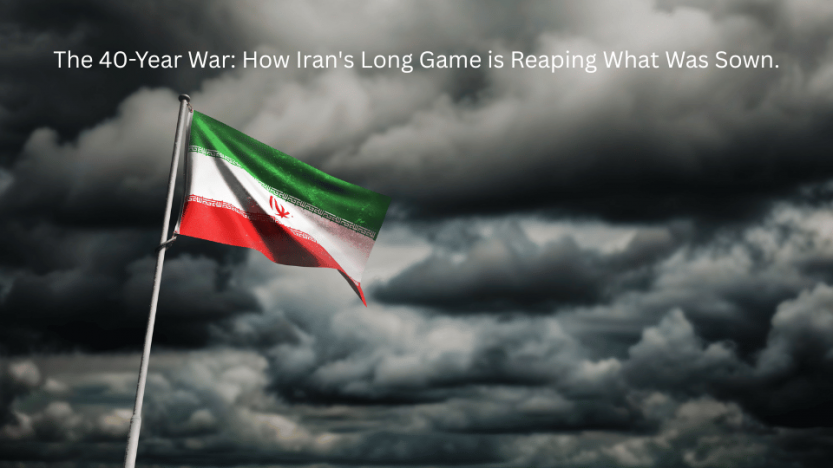
For forty years, the Islamic Republic of Iran has been preparing for a war it claims it does not want but has never stopped building towards. From the fertile crescent of Lebanon to the Red Sea shores of Yemen, from the deserts of Syria to the streets of Gaza, Iran has constructed a “Ring of Fire” around its adversaries.
Yet, as the region now teeters on the brink of a full-scale conflagration, it is crucial to understand that the missiles flying tonight are not just the product of recent tensions—they are the culmination of a strategy four decades in the making, one that was secretly armed by a fellow Muslim nation over thirty years ago.
The story of Iran’s military capability cannot be told without acknowledging the role of Pakistan. In the late 1980s and throughout the 1990s, while the world focused on the Soviet withdrawal from Afghanistan, a clandestine network led by Pakistani scientist A.Q. Khan was dismantling the global non-proliferation regime. It was during this period, in 1987, that a secret agreement was reportedly struck in Dubai. Iran received the keys to the nuclear kingdom: P-1 and P-2 centrifuge designs, thousands of components, and the technical blueprints necessary to enrich uranium.
Former Iranian President Akbar Hashemi Rafsanjani later confirmed this cooperation, noting that Pakistan had agreed to deliver “second-hand first-generation centrifuges” to help Iran build its own capability.
The CIA estimated that this transfer of technology—facilitated with the likely knowledge of senior Pakistani military brass—shortened Iran’s nuclear timeline by nearly a decade. Without that boost from Islamabad, the centrifuges spinning today at Natanz and Fordow might still be a distant dream rather than a direct threat to regional stability.
For Iran, however, the nuclear pathway was just one pillar of a four-decade-long doctrine of “strategic patience.” While the Gulf states spent billions on fleets of fighter jets, Iran invested in ballistic missiles. While others sought Western security guarantees, Tehran built proxy armies. The Islamic Revolutionary Guard Corps (IRGC) was transformed from a revolutionary militia into a sprawling military-industrial complex with its own air force, navy, and cyber command. The goal was not to win a conventional war but to make any war against Iran too costly to contemplate.
The result is the “Axis of Resistance”—Hezbollah in Lebanon, the Shia militias in Iraq, the Houthis in Yemen, and Hamas in Palestine. This network allows Iran to project power across the region while insulating itself from direct retaliation.
For decades, it worked.
Iran successfully destabilised its rivals, expanded its influence to the Mediterranean, and created a situation where it could bleed its enemies without shedding its own blood.
But history has a way of catching up. The events of the last year have revealed the fundamental flaw in Iran’s 40-year strategy. While it can project chaos, it cannot protect its own people from the consequences of its adventurism. The repeated strikes against Israel—whether direct or via proxies—have finally drawn a unified response. The same missile arsenal built over four decades is now being depleted in a war of attrition that Iran did not anticipate fighting on such a scale.
Moreover, the “ring of fire” is beginning to burn the hand that built it.
The people of Iran, crushed under the weight of sanctions and a stagnant economy, are not beneficiaries of this war preparation—they are its victims.
The billions spent on arming Hezbollah and the Houthis have not bought security; they have bought isolation, inflation, and the constant specter of military escalation.
As we witness the current conflict unfold, we must remember the choices that led us here. When Pakistan secretly supplied Iran with nuclear technology in the 1990s, it was sold as a gesture of Islamic solidarity.
When the West turned a blind eye to Iran’s proxy wars in the 2000s, it was dismissed as manageable containment. When the international community allowed the JCPOA to wither without a sustainable alternative, it was treated as a diplomatic failure rather than a security crisis.
We are now living with the consequences of those decisions. Iran has spent 40 years preparing for this moment.
The question remains whether the rest of the world—and the region—has the will to respond effectively, not just with military force, but with a strategy that addresses the root of this instability.
For the people of the Middle East, who have suffered through decades of sectarian conflict, economic hardship, and foreign interference, the hope must be that this long war finally comes to an end. But as the history of the last forty years shows us, hope is not a strategy. Only a clear-eyed understanding of how we got here—and who armed the actors—can guide us toward a more stable future.
Sunahwar Ali is a former Chief Whip of Tower Hamlets Council and an anti-racist, anti-injustice, and anti-corruption campaigner based in London, Sylhet, and Dhaka.
বিষয়: #How #Iran #War #year


 Murder Accused Hacked to Death in Cumilla’s Titas; Foreign Pistol Recovered
  BRAC Medhabikash Shongjog 2026
  HONOR 600 series launched with AI Image to Video 2.0 feature
  BRAC publishes its 2025 Annual Report 26 Million People Reached in One Year
  Tower Hamlets elects 45 ward councillors
  Lutfur Rahman elected Mayor of Tower Hamlets
  Sutang River in Peril: Microplastics and Heavy Metals Threaten Food Chain
  Gang of 6 Involved in Electric Transformer Theft Arrested in Habiganj
  Kalainjura Govt Primary School Devastated by Today’s Cyclone